Eurocities – Food systems in play: Amsterdam’s long game for fairer futures
The first CLEVERFOOD peer-learning visit took place in Utrecht and Amsterdam from 14-16th of April.

Facilitated by Eurocities, and hosted by Amped (as Guiding Entity of the peer-learning programme) and the EU4Advice Living Lab, participants from Marseille and Wallonia embarked on a two-day visit that was full of exchange and learning opportunities. Through field visits to Grounded Community in Utrecht, the Nieuw-West food market (Plein ’40-’45) and Voedselpark Amsterdam, participants got insights into how Amsterdam and Utrecht are transitioning to a fair and local food system.
Today, Wilma Dragonetti of Eurocities published an article reflecting on this peer-learning visit:
Food systems in play: Amsterdam’s long game for fairer futures

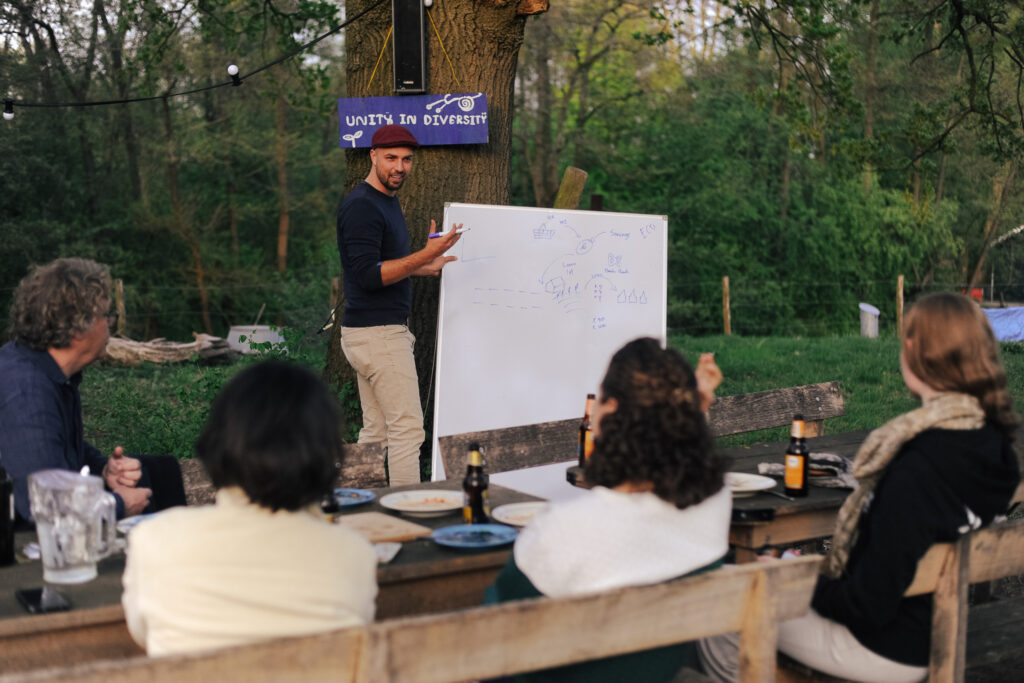
In a warehouse office on the outskirts of Amsterdam, Mark Frederiks, Managing Director of Amped, describes food systems like a game. Not because feeding a city is easy, but because it involves different layers of challenges that have to be played through. At the most basic level, there are the practical tasks: organising farms, moving food, setting up markets. Then comes the layer of networks and leadership, where personalities and power struggles can make or break cooperation. And finally, at the highest level, comes co-creation: working out new ways to collaborate and, crucially, deciding what has real value.
“You can have the best technical solutions, but if the people around the table don’t trust each other, it stops right there,” Frederiks explains.

It is from this perspective that Amped, the organisation Frederiks co-founded, has been developing networks for more than a decade. Amped is small, but its reach is surprisingly wide: a youth community of more than 650 active members in Utrecht; the EU4Advice living lab for Central Europe, active in Amsterdam and Utrecht, connecting advisors, policy makers, and supply chains across Europe; partnerships with ecosystem restoration movements; and engagement with international agri-business networks that bring stakeholders together from every continent. At the heart of it all is a single question: how can we organise food systems in a way that keeps value local, fair, and sustainable?
A philosophy of networks
Amped’s approach is less about building one project and more about building networks of projects. Each initiative – whether it is a short food supply chain start-up, a youth-led food campaign, or a tool for community finance – serves as a node in a larger web. This design is intentional: resilience in the food system, Amped argues, will come from many interlinked communities and actors able to share risks and rewards.

Central to this work is the idea of valuing what markets ignore. Many of the benefits grassroots food networks create don’t show up in standard accounting. Amped has experimented with ways to make those invisible values visible, including early trials with blockchain technology.
In this context, blockchain is a digital tool to track food and money flows transparently. By using it, Amped has tested how communities could keep more of the wealth generated by food within their neighbourhoods. “We initiated the first agricultural blockchain in the Netherlands eight years ago,” Frederiks notes. “It was about asking: why can’t we keep value circulating in our system, instead of giving it away?”
The Cleverfood study visit: lessons in Amsterdam
This is what delegations from Cellule Manger Demain in Belgium, and the Cité de l’Agriculture in Marseille found out during a Cleverfood study visit to Amsterdam.
The visit centred around Nieuw-West, one of Amsterdam’s poorest districts, where participants saw both promise and challenge. They visited a thriving community garden and a bustling street market, located within walking distance of each other yet serving very different populations. One attracted middle-class residents interested in ecological gardening, the other served low-income households with limited food budgets. The challenge, and the opportunity, was how to connect these initiatives across economic and cultural divides.

Amped showed how the district of Nieuw-West worked with a local community leader to better understand residents’ food needs, and how municipal support could be channelled into both improving access to healthier food and creating new economic opportunities for local people. For participants, this was a powerful illustration of what inclusive food governance looks like when underserved communities are not simply recipients but active shapers of solutions.
The peer learning was immediate. As Roberta Rigo from the Cité de l’Agriculture reflected: “The visit at Amped allowed me to take a step back and reflect on our role as collective dynamics facilitators… I go back home with a theoretical framework and a powerful narrative that explains what we do.” For Romane Cloquet from Cellule Manger Demain, the main lesson was the diversity of ways to weave connections between stakeholders.
The following month, Amped visited Pau in France in return, as part of the peer-learning programme.